
What Is Telemedicine and Why It Matters Today

Updated: Apr 8

Over 75 percent of American adults have used digital healthcare services, reshaping how busy people manage their well-being. For many American professionals balancing tight schedules, finding time for doctor visits can seem impossible. Virtual healthcare unlocks flexible access to expert advice and home delivery of medications, making weight management, sexual health, and longevity therapies more practical than ever. Discover the essentials of modern telemedicine and how it fits seamlessly into your demanding lifestyle.
Table of Contents
Key Takeaways
Point | Details |
Definition of Telemedicine | Telemedicine utilizes digital technology for remote clinical services, focusing on direct patient interactions. |
Advantages | It enhances accessibility and convenience, allowing patients to consult healthcare providers from home. |
Types of Services | Key telemedicine modalities include clinical video visits, remote patient monitoring, and store-and-forward technology. |
Comparison with Traditional Care | Telemedicine offers similar clinical outcomes but improves convenience and reduces geographical barriers compared to in-person visits. |
Telemedicine Defined: Virtual Healthcare Essentials
Telemedicine represents a transformative approach to healthcare delivery that leverages digital technologies to provide remote clinical services. Defined by the Congressional Research Service as remote clinical services facilitated through telecommunications technology, telemedicine enables healthcare professionals to diagnose, treat, and monitor patients without traditional in-person encounters.
At its core, telemedicine encompasses various modalities including clinical video consultations, remote patient monitoring, and advanced store-and-forward technologies. Unlike broader telehealth services, telemedicine specifically focuses on direct clinical interactions. Telehealth covers a wider range of health-related electronic communications, including preventive care, administrative functions, and provider education, whereas telemedicine zeroes in on clinical diagnosis and treatment performed remotely.
The primary advantages of telemedicine include increased accessibility, reduced travel requirements, and more convenient healthcare experiences. Patients can now consult with medical professionals from the comfort of their homes, eliminating geographical barriers and minimizing time spent in waiting rooms. This approach proves particularly beneficial for individuals with mobility challenges, those living in rural areas, or busy professionals seeking efficient medical consultations.
Pro tip: Before your first telemedicine consultation, ensure you have a stable internet connection, a private space, and your medical history information readily available to maximize the efficiency of your virtual healthcare experience.
Major Types of Telemedicine Services Explained
Telemedicine encompasses several sophisticated service models designed to meet diverse healthcare needs. Clinical video telehealth represents one primary modality, enabling real-time audio-video communication between patients and healthcare providers, allowing for immediate consultation and diagnosis without physical presence.
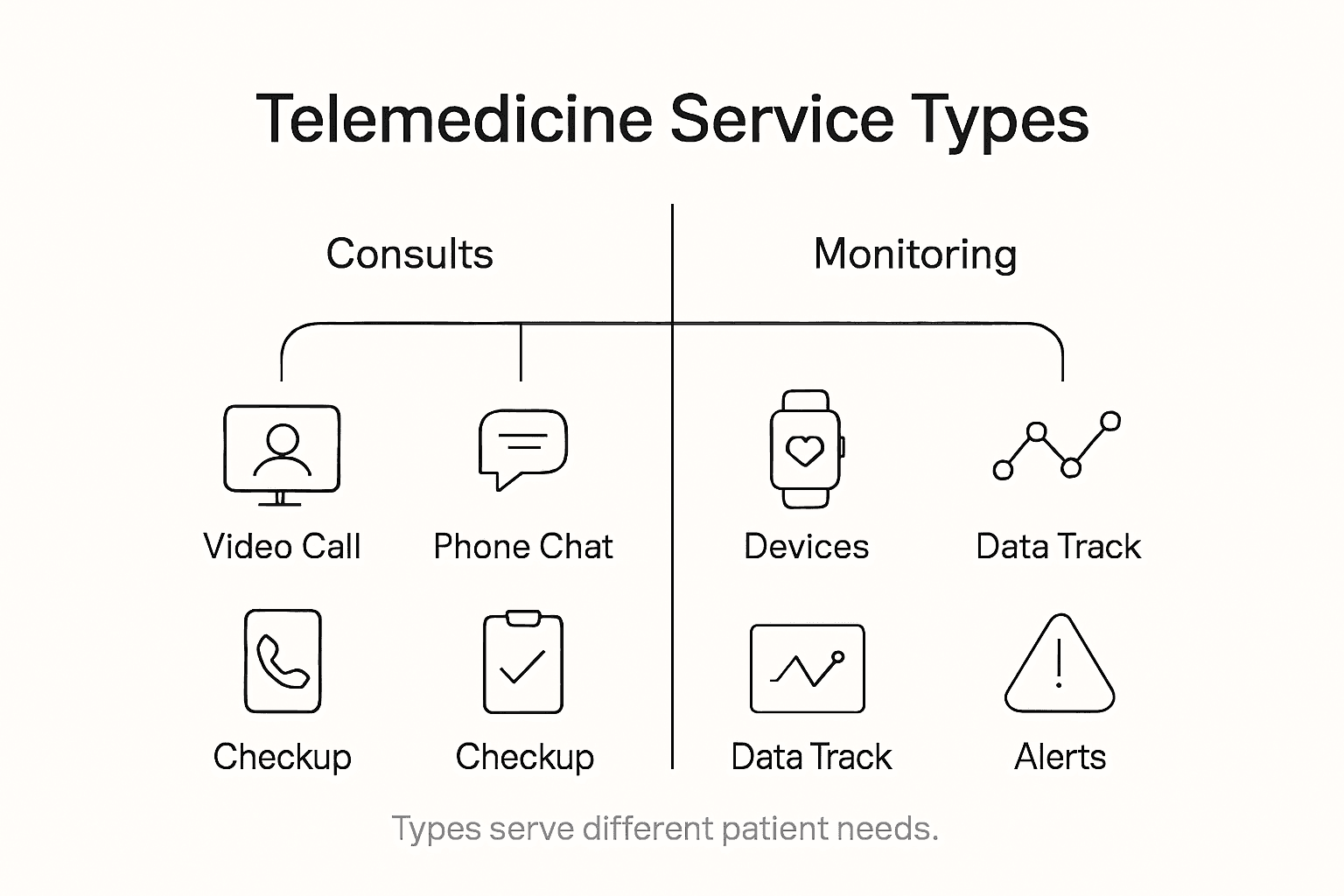
Another critical telemedicine approach is remote patient monitoring, which allows healthcare professionals to track patients’ health data continuously from a distance. This method proves especially valuable for managing chronic conditions, tracking vital signs, and providing proactive medical interventions. Technological approaches include both synchronous (live video/audio) and asynchronous (store-and-forward) communication methods, giving medical teams flexible options for patient care.
The third major telemedicine service type is store-and-forward technology, which enables medical professionals to transmit and review patient medical information like images, test results, and diagnostic reports electronically. This method is particularly useful in specialized fields such as dermatology, radiology, and pathology, where visual documentation plays a crucial role in diagnosis. These services collectively represent a comprehensive approach to delivering healthcare that transcends traditional geographical and logistical limitations.
Here is a summary of the main telemedicine service types and their primary use cases:
Service Type | Core Function | Common Use Cases |
Clinical Video Visits | Real-time video consultations | On-demand diagnoses, follow-ups |
Remote Patient Monitoring | Track health data remotely | Chronic illness management |
Store-and-Forward | Transmit and review medical info | Dermatology, radiology, pathology |
Pro tip: When exploring telemedicine services, confirm your healthcare provider’s specific technological capabilities and ensure your personal technology meets the necessary connection and privacy requirements.
How Telemedicine Visits and Prescriptions Work
Telemedicine visits transform healthcare delivery through comprehensive digital interactions, providing patients with convenient and efficient medical consultations. The process begins with scheduling an online appointment, typically involving a secure video platform where patients can connect directly with licensed healthcare providers. Patients verify their identity, share medical history, and discuss current health concerns in a virtual environment that mimics traditional in-person medical consultations.
During the virtual consultation, healthcare providers conduct thorough assessments using digital communication tools. Medical professionals document care details, verify patient information, and manage follow-up recommendations through electronic health record systems. These interactions can include comprehensive examinations, prescription recommendations, and treatment plans, all accomplished without requiring physical presence. Some consultations may utilize audio-visual technology, with audio-only options permitted under specific regulatory circumstances.
The prescription process in telemedicine is equally streamlined. After a comprehensive virtual evaluation, healthcare providers can electronically issue prescriptions directly to patients’ preferred pharmacies. This digital approach eliminates traditional prescription barriers, allowing patients to receive medications conveniently and quickly. The electronic prescription system ensures accurate medication management, with specific requirements varying by healthcare provider, insurance carrier, and current medical regulations.
Pro tip: Prepare a reliable internet connection, quiet private space, and have your medical history and current medication list readily available to maximize the efficiency of your telemedicine consultation.
Legal and Privacy Standards for U.S. Telemedicine
U.S. telemedicine legal standards create a comprehensive framework designed to protect patient privacy and ensure quality healthcare delivery. The primary legal foundation centers on the Health Insurance Portability and Accountability Act (HIPAA), which mandates strict protocols for safeguarding patient medical information during digital healthcare interactions. These regulations require healthcare providers to implement robust security measures that protect personal health data transmitted through electronic platforms.
Medical licensing requirements present another critical aspect of telemedicine legal standards, with regulations typically tied to the patient’s geographic location. Providers must be licensed in the state where the patient resides, creating a complex landscape of interstate practice limitations. This approach ensures that practitioners meet specific state-level professional standards and maintain accountability for the care they provide through digital channels.
The legal framework surrounding telemedicine continues to evolve, particularly in response to increased digital healthcare adoption during the recent pandemic. Key considerations include patient consent, data encryption, secure communication channels, and maintaining the same standard of care expected in traditional medical settings. State medical boards and federal agencies are continuously refining regulations to balance innovation with patient protection, addressing emerging challenges such as cross-state consultations, electronic prescription management, and the integration of new medical technologies.
Pro tip: Always verify your healthcare provider’s specific telemedicine credentials and confirm their compliance with state-specific medical licensing requirements before beginning a virtual consultation.
Comparing Telemedicine to Traditional Healthcare
Telemedicine offers a revolutionary approach to healthcare delivery, producing clinical outcomes remarkably similar to traditional in-person medical encounters. The primary distinctions lie not in medical effectiveness but in accessibility, convenience, and patient experience. While traditional healthcare requires physical presence, telemedicine eliminates geographical barriers, enabling patients to consult specialists and receive ongoing care without extensive travel or waiting room time.
The clinical effectiveness of telemedicine has been thoroughly validated across multiple medical domains. Research demonstrates that virtual healthcare visits can deliver equivalent health outcomes, particularly for chronic condition management and specialized consultations. However, telemedicine is not a universal replacement for traditional care. Certain medical scenarios still necessitate physical examinations, diagnostic imaging, or hands-on assessments that cannot be conducted remotely. The most effective healthcare models will likely integrate both telemedicine and in-person services, leveraging each approach’s unique strengths.
Key differences between telemedicine and traditional healthcare extend beyond medical consultation. Telemedicine introduces unprecedented convenience through reduced wait times, flexible scheduling, and the ability to consult healthcare providers from home. Patients can receive continuous monitoring, rapid prescription management, and specialized care that might previously have been logistically challenging. Technology enables more frequent touchpoints with healthcare providers, potentially improving long-term health management and patient engagement.
The table below compares telemedicine and traditional healthcare on key aspects:
Aspect | Telemedicine | Traditional Healthcare |
Accessibility | Nationwide, home-based access | Restricted by location |
Convenience | Flexible, minimal wait times | Fixed appointments, longer waits |
Assessment | Digital exams, limited physically | In-person, full physical exams |
Prescription | Electronic, sent to local pharmacy | Handwritten or e-scripts |
Pro tip: Choose a healthcare provider offering hybrid care models that seamlessly combine telemedicine and in-person services to ensure comprehensive medical support tailored to your specific health needs.
Experience the Convenience of Telemedicine with Guppy Meds Today
The article highlights how telemedicine removes traditional barriers like travel time and waiting rooms while delivering essential healthcare right to your home. If you are looking for a simple, private way to connect with licensed healthcare providers, get personalized treatment plans, and receive prescription medications quickly, Guppy Meds offers a trusted platform designed just for that. Our service focuses on delivering care in key areas like weight loss treatments including GLP-1, sexual health, peptides, and longevity therapies all through secure virtual consultations.
Take control of your health without compromising your busy schedule or privacy. Visit Guppy Meds to explore how easy it is to schedule your telemedicine consultation online, receive medications from an FDA-registered pharmacy, and enjoy a subscription-based approach tailored to your needs. Don’t wait for traditional healthcare challenges to slow you down. Start your journey to optimized health now with Guppy Meds and embrace a seamless telemedicine experience that truly puts you first.
Frequently Asked Questions
What is telemedicine?
Telemedicine is a healthcare delivery method that uses digital technologies to provide remote clinical services, allowing healthcare professionals to diagnose, treat, and monitor patients without needing in-person visits.
How do telemedicine visits work?
Patients schedule online appointments through a secure video platform where they can connect with licensed healthcare providers, share medical history, and discuss health concerns in a virtual environment that mimics traditional consultations.
What are the main types of telemedicine services?
The main types of telemedicine services include clinical video visits, remote patient monitoring, and store-and-forward technology, each offering different approaches to meet various healthcare needs.
Are telemedicine visits as effective as in-person consultations?
Yes, telemedicine visits have been shown to deliver clinical outcomes similar to those of traditional in-person visits, especially for chronic condition management, though some situations still require physical examinations.
Recommended


Comments